
本体聚合
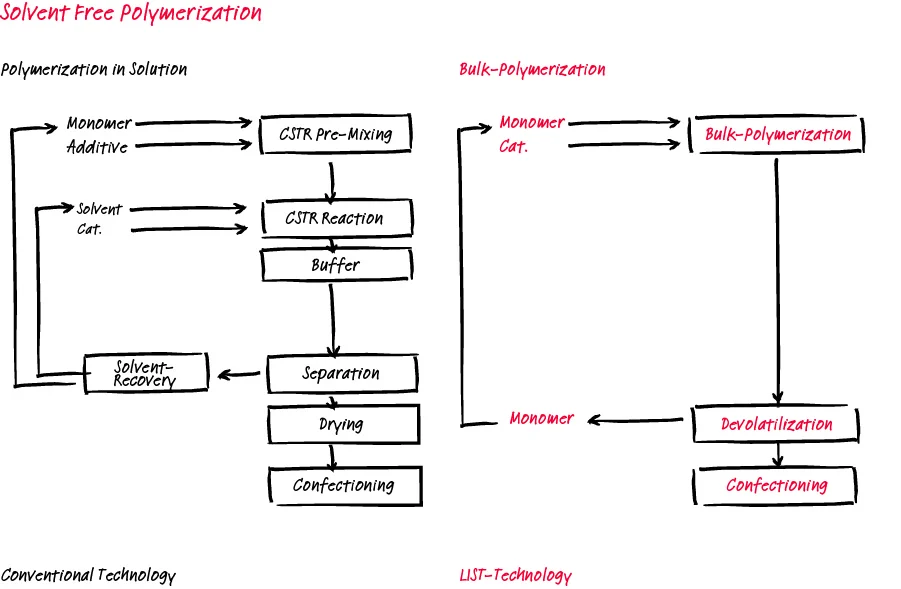
传统的聚合物生产工艺需要大量溶剂。LIST 的捏合反应器提供了一种高效的替代方案。
LIST 捏合反应器能够在高浓度、无溶剂的相态中聚合单体和催化剂,轻松实现 90% 至 99% 的转化率。
在聚合后的第二阶段,聚合物熔体可直接脱气至残余单体含量为 1000 ppm 或更低。
对于放热的本体聚合过程,LIST 捏合反应器的大换热面积结合蒸发冷却,有助于精确控制产品温度。
混合元件的独特几何形状确保了表面的持续更新,从而优化了热传递,并最大限度地减少了产品积聚和死区。
特性
示例
聚甲基丙烯酸甲酯 (PMMA)
在 LIST 捏合反应器中,甲基丙烯酸衍生物的本体聚合转化率可达 98%。多分散性指数 (PDI) 值可达到 1.5…2.0。
高吸水性树脂 (SAP)
丙烯酸在水性本体聚合工艺中进行聚合,聚合物产率高达 45%。LIST 捏合反应器中的精确温度控制可实现非常窄的多分散性指数 (PDI) 分布。SAP 以自由流动的材料形式从捏合机中排出。
下载
The bulk free radical polymerization of methyl methacrylate (MMA) or the bulk free radical copolymerization of MMA based monomer recipes face a gel effect (Trommsdorff’s effect) and exothermicity. The kneader reactor offers a perfect combination of surface renewal and evaporative cooling to control temperature at high conversion (85 to 95%).
Language: English / Year: 2006
A new type of kneader reactor is proposed for the continuous radical (co-) polymerisation without solvent, based on the proven design of mature (kneader-) dryer technology. The reactor has been developed to satisfy all major aspects required for (co-) polymerisation while maintaining the safety and reliability of the previous mechanical design. The new kneader reactor offers a perfect combination of surface renewal and evaporative cooling to control temperature to high conversion (85 to 95%), even for bulk systems that have a strong gel effect (Trommsdorff’s effect) and high exothermicity.
Language: English / Year: 2006
A review of the existing polymerisation processes is proposed, with particular attention to the control of viscosity and heat removal. Up to the present time, different types of reactor have been developed in order to improve the stability of the polymerisation process. A review of these reactors is presented for the heterogeneous and homogeneous polymerisations. The production of solid polymer granules directly in a kneader reactor under evaporative cooling is seen as an efficient and reliable polymerisation technology.
Language: English / Year: 2001
Various types of reactor have been developed to date for improving the stability of the polymerisation process. This review describes a few examples of heterogeneous and homogeneous polymerisation, focusing particularly on viscosity control and heat removal. The production of solid polymer granules directly in a kneader-reactor with evaporative cooling is one efficient and reliable polymerisation technology.
Language: English / Year: 2003
Sie suchen ein lösungsmittelfreies, sicheres, umweltfreundliches und energieeffizientes Herstellungsverfahren, das neue Produkttypen mit neuen Qualitätsmerkmalen hervorbringt? Eine neue Technologie macht’s möglich.
Language: German / Year: 2009
Mit lösemittelfreier Prozessführung, dem sogenannten Dry Processing, lassen sich zwei entscheidende Ziele erreichen: umweltfreundliche Prozesse und eine deutliche Senkung der Investitions- und Betriebskosten. Die Schweizer Firma List konzentriert sich dabei nicht auf einzelne Verfahrensschritte, sondern auf den Prozess als Einheit, um eine ganzheitliche verfahrenstechnische und wirtschaftliche Optimierung zu erreichen.
Language: German / Year: 2009
Batch trials were performed on a kneader reactor where a bulk co-polymerization was carried out. Polymerization conversion, viscosity build, reaction kinetics, and heat transfer calculations were performed using the experimental data from the batch trials. A continuous process was proposed for this bulk copolymerization and the models and results from the batch trials were used in designing the continuous process. Predictions of the continuous process using the batch trial data are compared to the actual continuous process, with a focus on polymer conversion, heat transfer, and torque prediction.
Language: English / Year: 2007
Converting the polymer industry to solvent-free polymerisation processes and avoiding unnecessary recirculation decreases energy consumption and reduces waste production. This can be achieved with the horizontal large-volume Kneader Reactor with superior mixing and homogenisation performance. The casing, shafts and mixing elements are indirectly heated by heat transfer fluids and dynamically self-cleaning.
Language: English / Year: 2012
Are you looking for a solvent-free, safe, eco-friendly and energy-efficient way of producing new types of products with new levels of quality? New technology is available to help you do exactly that.
Language: English / Year: 2009